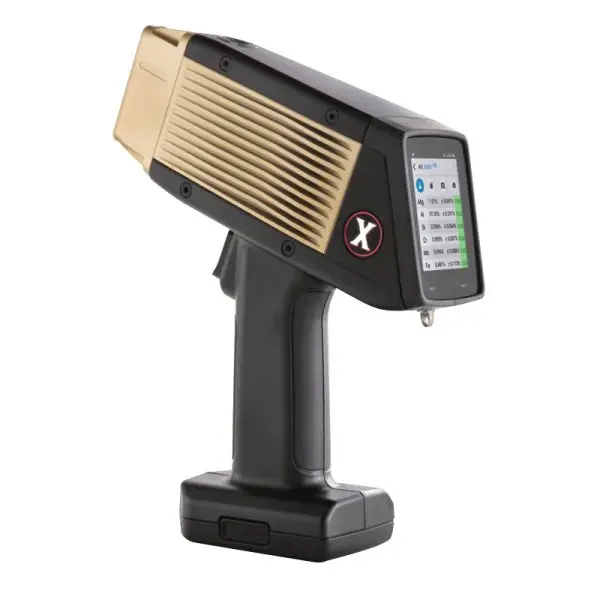
The second generation GEMORO XRF PRO Analyzer is our premium handheld, portable Energy Dispersive XRF Spectrometer model that uses an advanced SDD detector. The sleek new GEMORO XRF PRO Analyzer is our lightest, smallest, fastest, high-precision XRF analyzer under 3 lbs. This is especially beneficial when you’re using it all day long.
With all the features of the original GEMORO XRF Analyzer with enhancements such as a sharper display readout, it’s designed for jewelers, pawnshops, appraisers, precious metals buyers, high volume scrap buyers and manufacturers that demand the best. When gold prices soar, you need the efficient, super-fast, non-destructive testing used in the GEMORO XRF PRO.
Since XRF reads surface composition, plated items—especially gold-plated silver, copper, or base metals—can appear to be solid gold if only the outer layer is analyzed. To improve accuracy, test the original surface first, then, file a small spot and re-test that exact location. This second test gives the analyzer better penetration through any plating allowing you to measure Zinc (Zn), Copper (Cu), Nickel (Ni), or Silver (Ag) that may be present in higher-than-normal concentrations that exceed the typical manufacturing standards. In addition to elevated Zn, Cu, Ni, or Ag concentrations to indicate potential plating, one must also be cognizant if/when Tungsten (W) is present at any concentration as this is a direct indicator that the sample is plated. Tungsten is widely used for gold-filed materials
Elements that can be detected include titanium (Ti), vanadium (V), chromium (Cr), manganese (Mn), iron (Fe), cobalt (Co), nickel (Ni), copper (Cu), zinc (Zn), tungsten (W), iridium (Ir), platinum (Pt), gold (Au), lead (Pb), bismuth (Bi), zirconium (Zr), molybdenum (Mo), ruthenium (Ru), rhodium (Rh), palladium (Pd), silver (Ag), cadmium (Cd), tin (Sn), and antimony (Sb). Does not measure for Aluminum (Al), Magnesium (Mg), or Silicon (Si).
Each unit includes two 6-hour long-lasting rechargeable batteries and an AC adapter. The ability to set a passcode access parameter to manage user access. WIFI/Bluetooth/USB connection capabilities allow you to quickly send sample images and test results to your computer for easy filing. This stylish, black and gold, feature-rich unit comes with a protective Pelican Case both ensuring it arrives in perfect condition and enabling you to easily carry it into the field.
Key Features:
- High-speed, ultra-portable spectrometer with premium X-ray tube and SDD detector
- Lightweight design (under 3 lbs.) and optimized design allows easy usage
- Provides efficient, super-fast, non-destructive testing
- Superior 2.7" color touchscreen with dual displays readable in all conditions
- Dual integrated cameras for sample viewing, targeting, photo documentation, and barcode scanning
- Built on Android/Qualcomm architecture with advanced Wi-Fi, Bluetooth, GPS & USB connectivity
- Manage data anywhere—print, email results, or connect to any information management system
- Password-protected security (user & admin levels)
- Fully portable with rechargeable Li-ion battery or AC power and protective pelican case.
Specifications:
Testing Area: 4mm Diameter
Measuring Depth: 10-20 Microns
Tube Life Expectancy: 8,000 Hours or 2.8M ~10 Second Tests
Tube Specification: 40K V, 200uA Rh Anode, 1 Beam
Detector Rate 7 mm2 SDD, Silicon Drift Detector, (active area), 170 eV resolution FWHM at 5.95 Mn K-alpha line
Camera: Built-in, high-resolution camera for sample viewing and a macro-camera for photo-documentation or 2D/3D barcode reading and storage
Battery Life: Includes AC Adapter and 2 Rechargeable Batteries (6 Hours/Battery)
Certifications: CE, RoHS, USFDA, Canada RED Act
Product Weight: 2.98 Lbs. with Battery
Dimensions: 8.5” x 9.5” x 2.4”
Data Transfer: WIFI, Bluetooth, USB Connectivity to Most Devices
Calibration Check: Manually Applied 316 Stainless Steel Shutter – Included – is used for calibration when turning the device on and whenever the user desires without having to physically send their device to GEMORO to be recalibrated
Environmental Temp: 10°F to 130°F at 25% Duty Cycle
Security: Password Protected Usage (user level) and Internal Settings (admin)
Warranty: 3 -Year Warranty
Please note – every state has specific requirements for owning an X-Ray emitting machine. You will need to register your XRF by going to the Department of Health’s website for your state.
Best Practices for Safe Operation:
- Trigger finger should be the body part closest to the analyzer window.
- Run tests with the XRF pointed away from other people
- Pay attention to where the beam is pointed
- Don’t hold samples in your hand
- Maintain control of the analyzer
- Limit operation to trained personnel
XRF Spectrometry Data Method
XRF Spectrometry can use either Empirical Methods (calibration curves using standards similar in property to the unknown) or Fundamental Parameters (FP) to arrive at quantitative elemental analysis. The line of GEMORO XRF Gold & Precious Metal Analyzers use the superior Fundamental Parameters because it allows elemental analysis to be performed without standards or calibration curves, which is much more preferred. This enables the analyst to use the system immediately, without having to spend additional time setting up individual calibration curves for the various elements and materials of interest. FP, accompanied by stored libraries of known materials, determines not only the elemental composition of an unknown material quickly and easily, but can identify unknown materials as well.
More on How XRF works:
XRF works by striking a sample with an X-ray beam from an X-ray tube, causing characteristic X-rays to fluoresce from each element in the sample. A detector measures the energy and intensity (number of X-rays per second at a specific energy) of each X-ray, which is transformed into an elemental concentration using either a non-standard technique such as fundamental parameters or user-generated calibration curves. The presence of an element is identified by the element’s characteristic X-ray emission wavelength or energy. The amount of an element present is quantified by measuring the intensity of that element’s characteristic X-ray emission.
The Atomic Level
All atoms have a mixed number of electrons. These electrons are arranged in orbitals around the nucleus. Energy Dispersive XRF (EDXRF) typically captures activity in the first three electron orbitals, the K, L, and M lines.
These electrons are arranged in orbitals around the nucleus. Energy Dispersive XRF (EDXRF) typically captures activity in the first three electron orbitals, the K, L, and M lines.
The primary photons from the X-ray tube have high enough energy that they knock electrons out of the innermost orbitals, creating a vacancy (1). An electron from an outer orbital will move into the newly vacant space at the inner orbital to regain stability within the atom.
As the electron from the outer orbital moves into the inner orbital, it releases energy in the form of a secondary X-ray photon. This energy release is known as fluorescence. All elements produce fluorescence “characteristic” to themselves. Each element’s fluorescence is unique to itself.
| Brand | GEMORO® |
| Country of Origin | United States of America |